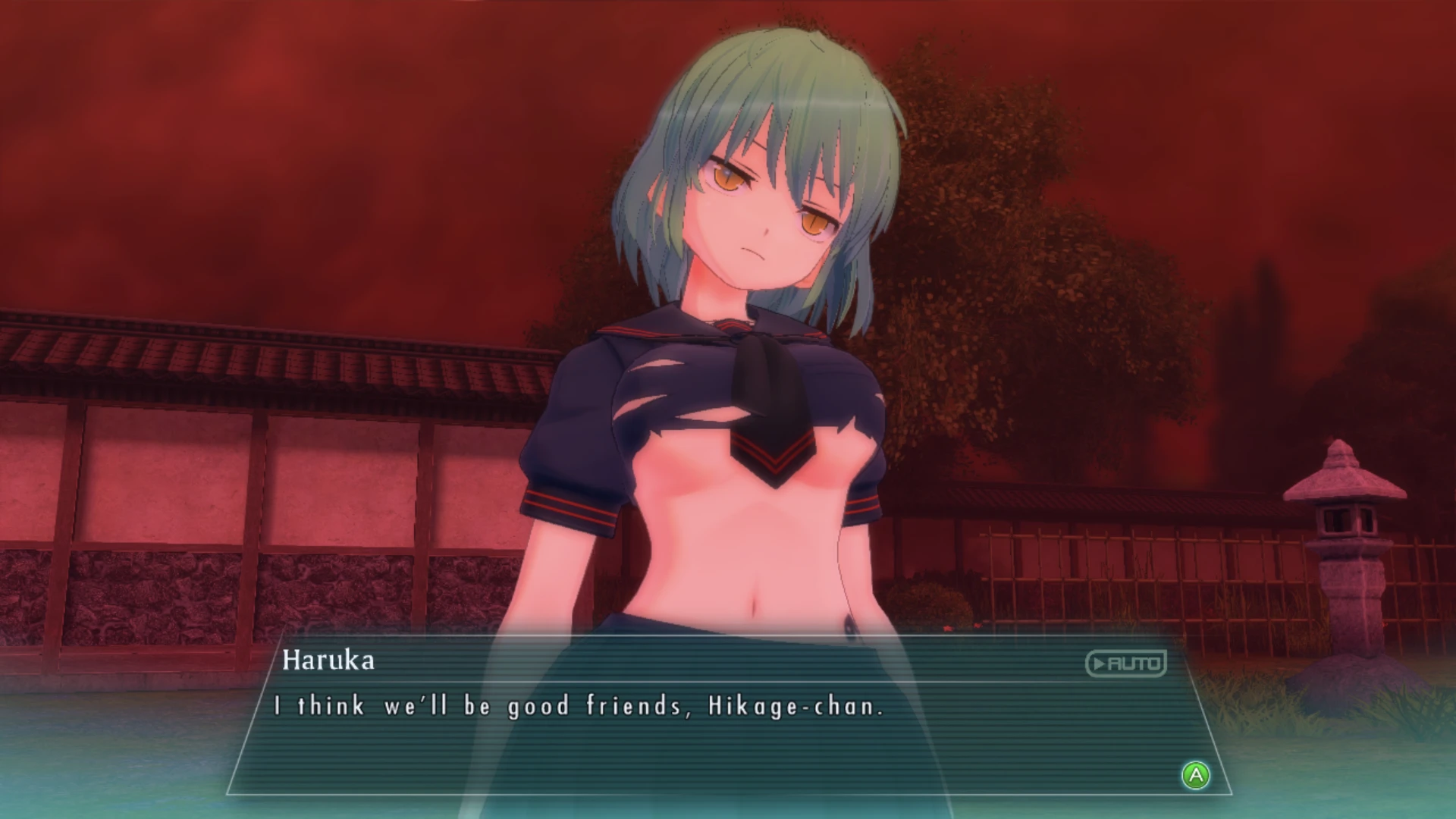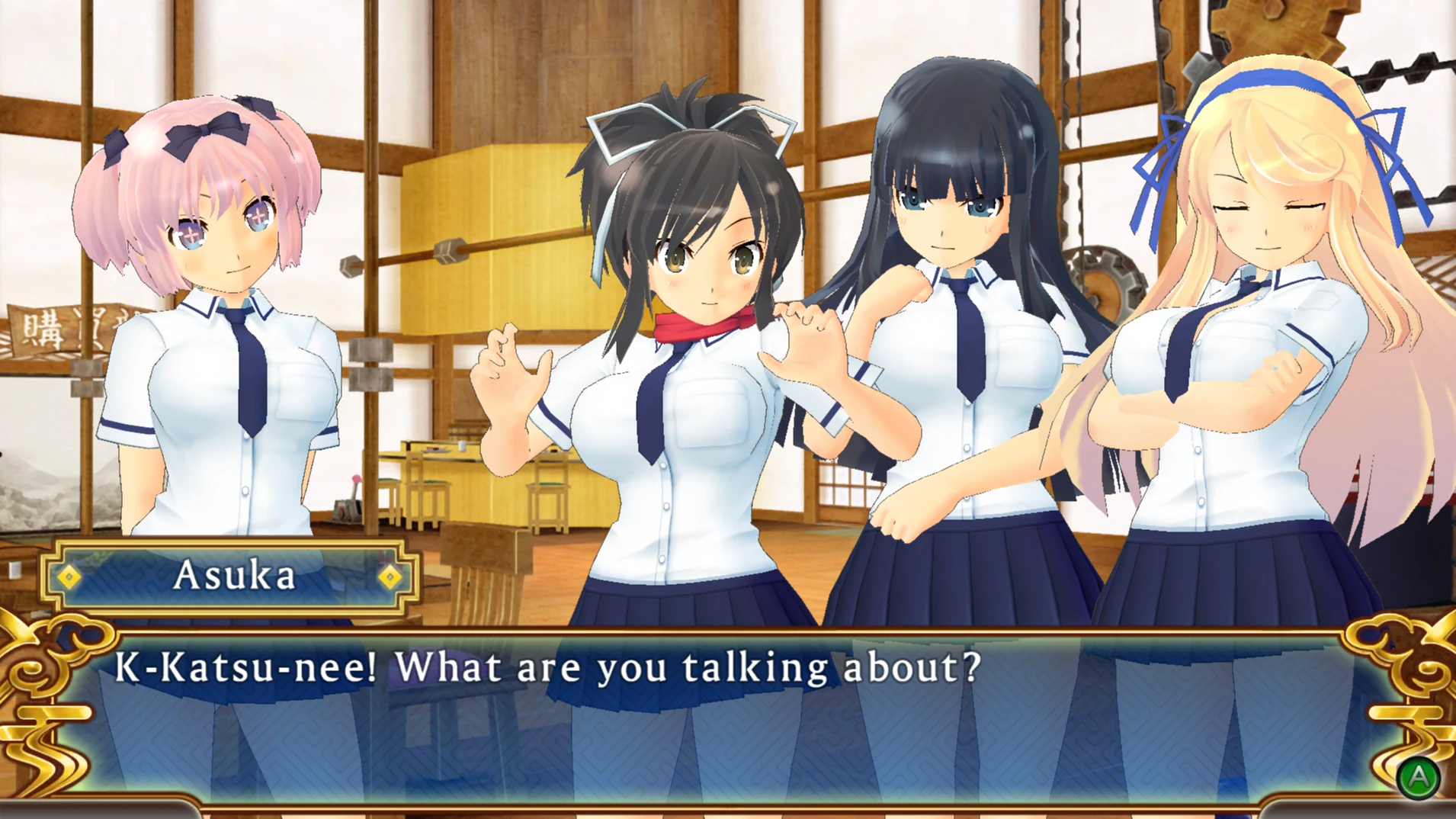
An English script restoration / uncensor for the PC version of SENRAN KAGURA SHINOVI VERSUS.
Why this patch exists
XSEED often expands the scripts it localizes. A plain line may become a joke. A restrained reaction may turn into a much louder outburst. In worse cases, the English changes a character's motive or gives a scene a different meaning.
Their own editors described this as part of the job. Jessica Chavez once compared editing to adding "cheese, chives and/or bacon." In the same interview, she said that she had amplified relationships and improvised while working on Trails in the Sky.
Estelle Bright is an easy example. XSEED made her sound younger and more childish than she does in Japanese. Expressions like some kinda training and the bad monsters were added in English. The recurring stick threats and punchlines are also largely XSEED's work. Most of them do not mention her staff in the Japanese script. Across the game, many ordinary lines are pushed much further or replaced with new jokes. Taken together, these edits make English Estelle more explosive and more aggressive than Falcom wrote her.
SHINOVI VERSUS was handled with the same freedom. Sometimes the change is a joke or a bit of slang. In other scenes it reaches the story itself. The official English also removes information from every playable character profile.
The UNBURGER Translation Patch restores the Japanese meaning and characterization while keeping the English natural.
Current status
The patch is fully functional and covers the entire game. It is still marked as beta because some lines may sound slightly unnatural in English. Very occasional errors may also occur. Future updates will continue polishing them as they are found during in-game testing or reported by players.
Who this patch is for
This patch is for players who use the English text but want the story and cast as they were originally written.
Players who prefer XSEED's added jokes and rewritten character voices may want to stay with the retail script. UNBURGER follows the original lines even when the official localization became more familiar in English-speaking communities or or considered something too "problematic".
What the patch changes
The entire English text was checked against the Japanese files and, where needed, the Japanese audio. Existing English lines were kept when they were accurate and already sounded natural. The rest were corrected or rewritten.
Character voices
The patch follows the way each character actually speaks in Japanese.
Hikage keeps her short, dry way of speaking and the traces of Kansai dialect present in Japanese. Daidouji keeps her archaic and imposing register. Yumi and Miyabi remain formal without sounding like stiff machine translations. Shiki keeps her gyaru-style speech. Homura sounds direct and casual instead of turning into a needlessly formal commander.
The patch also preserves first-person self-reference when the Japanese character actually speaks that way. Hibari, Minori, Ryoubi and Ryouna may refer to themselves by name. This was not added to every sentence. It appears only where the source supports it.
Honorifics and relationships
Honorifics are kept because they carry information that ordinary English titles often lose. The script uses forms such as -san, -chan, -kun, -senpai, -sensei and -sama where they appear in Japanese.
Family and relationship forms receive the same treatment. Direct forms such as Onee-chan, Nee-san, Nii-san and Onii-sama remain in the dialogue. A descriptive reference still uses normal English, such as older sister or younger brother. The translation decides between them from the scene and the relationship, not from a batch replacement.
Japanese name order and romanization
Names follow Japanese order: surname first, given name second.
Series terminology
忍 is translated as shinobi. Ninja is kept for places where the Japanese explicitly says 忍者 or ニンジャ, and for established names such as Ninja Art.
The script restores terms such as nukenin, Youma, Kagura and Jounin. Japanese food and cultural terms are retained when an English substitution would erase part of the setting. Examples include (but not limited to) mochi and surume.
Restored profile data
The Japanese profiles give an age for every playable character. XSEED removed that field from all 22 English profiles. UNBURGER restores it directly from the Japanese text.
The profiles also return to metric units. Heights are shown in centimetres. Body measurements use the original B: / W: / H: format instead of converted inches.
The profile descriptions were checked as well. Several had been shortened enough to remove parts of a character's background, personality or fighting style.
For example, Katsuragi's Japanese profile reads:
Literal meaning:
The official profile reads:
The restored profile reads:
Text that was censored or replaced
The removed ages are the clearest case of textual censorship. No age had to be guessed or taken from a wiki. The information was already present in the Japanese files.
The official English also avoids sexual harassment in scenes where the Japanese repeatedly uses セクハラ. It replaces the term with phrases such as cop-a-feel, invasion of privacy, queen of perverts or Path of the Squeezed Booby. This breaks recurring jokes and sometimes changes what Katsuragi is declaring.
The exact Japanese behind those examples is shown below.
Japanese:
Official English:
UNBURGER:
Japanese:
Official English:
UNBURGER:
Japanese:
Official English:
UNBURGER:
Japanese:
Official English:
UNBURGER:
The joke may be absurd, but it is the joke that was written for the game.
How far did the official script go?
The examples below deal with motives, characterization and the point of a scene. These are among the strongest changes found in the official script.
Homura's reason for leading the Crimson Squad
Homura explains that the others followed her because they looked up to her. She feels responsible for showing them a way forward. She wants to find something that only they can do as nukenin and that will make them feel truly alive.
Japanese:
Literal meaning:
Official English:
UNBURGER:
The official version turns her responsibility toward the group into doubt about whether their lives can be justified. It also has Homura say that they are no longer shinobi, which is not what the Japanese says.
Kurokage and the children he raised
Headquarters sent assassins after Kurokage because it believed that he planned to lead children orphaned by evil shinobi and resume his hunts.
Japanese:
Literal meaning:
Official English:
UNBURGER:
The official script adds revenge as the children's motive and turns Kurokage's personal hunts into a new war. That changes an important piece of his history and the reason headquarters acted against him.
Asuka and Homura's final promise
Japanese:
Literal meaning:
Official English:
UNBURGER:
The official line sounds like a promise to keep fighting throughout their lives. The Japanese says that the fighting ends when one of them dies.
Ryoubi on losing and death
Ryoubi tells her opponent that the complaint about “cheating” comes from not accepting that defeat can mean death.
Japanese:
Literal meaning:
Official English:
UNBURGER:
The official version replaces her argument with a new insult. It also introduces the strange idea of proving that someone is a shinobi by being able to “die like one.”
Murakumo's farewell
Japanese:
Meaning:
Official English:
UNBURGER:
A quiet goodbye became a threat. The change is short, but it gives Murakumo a different attitude in the scene.
Minori introducing herself
Japanese:
Meaning:
Official English:
UNBURGER:
The official script adds a verbal tic and removes the actual greeting. Changes like this appear throughout the game and gradually alter how a character sounds.
What was removed from the XSEED script
Added jokes were removed when they replaced the original line or changed the scene. The same applies to American slang and pop-culture references that had no basis in Japanese.
Some official lines changed who was acting. Others made uncertain statements sound definite. A few added reasons that the speaker never gave. Those lines were rebuilt from the Japanese rather than edited around the existing English.
The game's own humor stays. Good XSEED lines also remain when they convey the Japanese correctly.
Scope
The translation project contains 577 text units with 17,172 records in total.
| Area | Units | Records |
|---|---|---|
| Scenario and story text | 521 | 7,054 |
| Jimaku battle dialogue | 44 | 4,922 |
| System and interface text | 9 | 3,813 |
| Arcade Voice | 1 | 1,180 |
| Tutorials | 2 | 203 |
The current patch differs from the retail English in 6,703 records across 510 units.
The review covers all four school routes, the shared final story, arcade scenarios, profiles, tutorials, system text and Arcade Voice. Jimaku required a separate audio-based workflow because those lines do not have a complete matching Japanese text bank.
What the patch does not change
UNBURGER is a text patch. It does not alter character models, costumes, textures or camera work. It does not add scenes that were absent from the game.
The English follows normal English syntax. Sentences were restructured where needed, but the adaptation stops before it changes the meaning, tone or characterization.
Added Glossary
The game has a built-in glossary system. It contains explanations for game terms, lore, etc. I thought this would be the perfect mechanic to use for TL notes. The game has over 400 free slots in its files, so it didn’t take much effort to make use of them. Once I found where they were stored and how to reference them, the rest was easy.
As a result, many terms could be left in the original, preserving the game’s very Japanese feel. Less familiar words are accompanied by explanations.
Technical work
SHINOVI VERSUS stores its text in several different formats inside CAT archives. The tools extract those archives, export translator-facing JSON files and rebuild only the files needed by the game.
Story text uses TAMS commands. Many records do not contain an obvious speaker name beside the line, so speaker context had to be recovered from command data. Inline voice tags were also mapped because a single record can contain more than one voiced segment.
Arcade Voice uses a different layout. Its 1,180 records were divided into the game's exact 22 character sections. Tutorials and UTF-16 system files needed their own import and export paths.
Jimaku was the hardest part. The English files exist, but a complete Japanese text counterpart does not. The lines were mapped to sound events and transcribed from Japanese audio. Several early mappings were shifted, so matching by record number alone produced the wrong dialogue. The final workflow uses audio identity and character context instead.
Every rebuild preserves control codes, pauses, colors and line-break counts. Public releases contain record-level differences rather than a dump of the retail script. The title footer is generated from a clean local copy of the original title CAT and displays the current UNBURGER MOD version.
Build reports use relative paths only. Local game paths, user directories, fonts, extracted archives and ASR models are excluded from public packages.
Using the tools
The public scripts use Bash and Python 3. Start with a clean copy of the PC game files.
Code:
./01_unpack_game_files.sh
./02_create_translation_files.sh
The first script asks for the game directory and creates a local workspace. The second exports the text to
Code:
translation/Edit only the
Code:
en
Code:
translation/**/records[*].enBuild and export a diff-only patch with:
Code:
./05_build_translated_game_files.sh
./06_export_public_patch.sh
The footer asset is generated during the same build. The version is read from
Code:
UNBURGER_VERSIONFor release testing:
Code:
./08_run_release_qa.sh prepare --game-root "/path/to/Senran Kagura Shinovi Versus"
Code:
START_HERE.shTranslation status
Every text record in the game was reviewed. This includes the main story, side scenarios, profiles, Arcade Voice and Jimaku.
Like the earlier Burst Re:Newal project, this work began with the official English rather than a blank page. Accurate and natural lines were kept. The rest were changed when the Japanese showed a real problem with the meaning, the character voice, the terminology or the treatment of the source material.
The result is intended to read like normal English while staying with the game that Tamsoft wrote.
Installation
Extract the files to the game's main folder. When asked if you want to overwrite existing files, click "Yes."